What Are Acoustic Credits?
Sustainability and wellbeing rating systems reward buildings that provide good acoustic conditions for occupants and limit noise to neighbours. Each scheme sets its own criteria, but they commonly cover sound insulation between spaces, indoor ambient noise levels, reverberation in rooms used for speech, and noise from the building’s plant at nearby receptors.
Achieving the credits depends on setting the right targets early, carrying them through design, and verifying them with testing near completion.
Acoustic credits often carry good value within a rating, as many of the criteria align with what a well-designed building should achieve anyway. Missing them late in a project, however, can affect the overall rating target and leave little time to find points elsewhere.
When Do You Need Acoustic Input?
- At pre-assessment, to identify which acoustic credits are realistic for the project
- At concept and developed design, when wall, floor, glazing and ventilation strategies are fixed
- When plant is selected, to meet Pol 05 or equivalent noise criteria
- Before practical completion, when pre-completion acoustic testing is carried out
- When a BREEAM or LEED assessor or WELL reviewer requests evidence
Our input can be scaled to the project. Some clients need only a Pol 05 assessment for the plant; others need full Hea 05 or WELL Sound support from pre-assessment through to testing. We agree the scope with the design team and assessor at the outset so nothing is duplicated.
What We Assess
- Sound insulation between rooms, offices, classrooms, hotel bedrooms and dwellings
- Indoor ambient noise from external sources and building services
- Reverberation time and acoustic absorption in offices, teaching spaces, atria and meeting rooms
- Speech privacy and intelligibility in open-plan and cellular spaces
- Impact noise through floors
- Noise from the building at nearby sensitive receptors, using a BS 4142 based approach
The criteria that apply depend on the building type. Offices, schools, healthcare buildings, hotels and residential schemes each have different targets, and some spaces, such as plant rooms or circulation areas, may fall outside the assessment altogether. We confirm the room types in scope before design targets are issued.
Our Approach
We start by reviewing the scheme version, building type and credit targets with the sustainability assessor. We then set out the acoustic criteria in a design-stage report, review drawings, specifications and plant data as the design develops, and advise on construction details where performance is at risk.
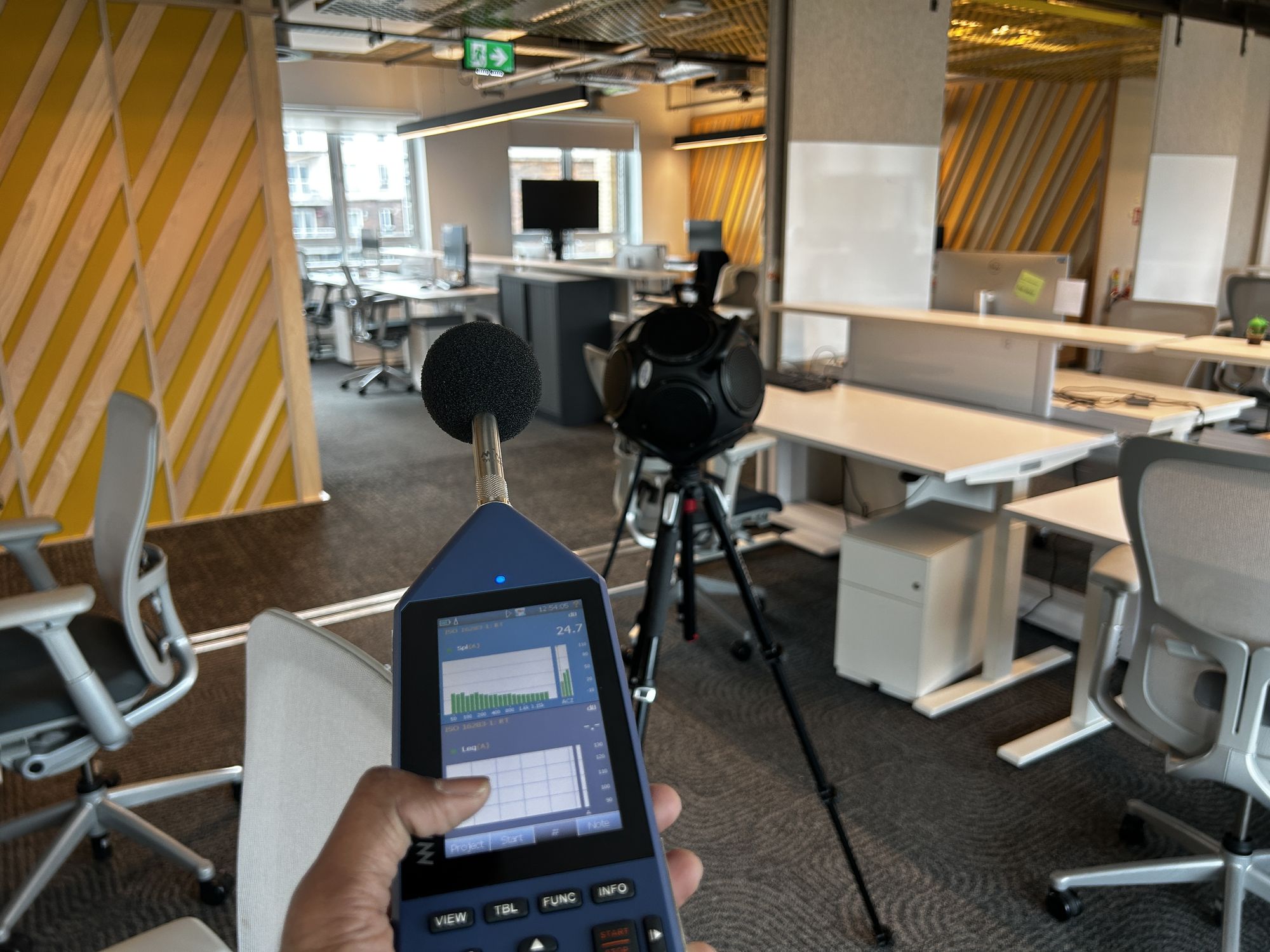
Near completion we carry out commissioning tests, including sound insulation testing, reverberation time testing, indoor ambient noise measurements and, where required, speech intelligibility testing. Any shortfall is identified with practical remedial advice before handover.
On mixed-use and hotel projects, we coordinate BREEAM or LEED criteria with building regulations requirements for sound insulation, so a single set of constructions and a single test programme satisfy both where possible.
Standards and Guidance
- BREEAM UK New Construction 2018: Hea 05 Acoustic Performance and Pol 05 Reduction of Noise Pollution
- BREEAM International New Construction, which uses equivalent acoustic and noise pollution issues adapted for use outside the UK
- LEED v4.1 Building Design and Construction: Acoustic Performance credit under Indoor Environmental Quality
- WELL v2: the Sound concept, including Sound Mapping, maximum noise levels, sound barriers, reverberation time and impact noise
- BS 8233:2014 and BS 4142:2014+A1:2019, which underpin many of the criteria
Criteria vary with building type and scheme version, so we confirm the exact requirements for each project before design targets are set.
Where the project is also subject to building regulations sound insulation requirements, such as Technical Guidance Document E in Ireland or Approved Document E in England and Wales, we show how those requirements and the rating criteria relate, so the design team works to one consistent set of targets.
What You Receive
- A pre-assessment note on which acoustic credits are achievable
- A design-stage acoustic report with targets and recommendations for the assessor
- Pol 05 or equivalent noise assessment for building services plant
- Pre-completion test reports in the format the assessor needs
- Clear statements of compliance against each credit criterion
Reports are written to make the assessor’s review straightforward, with each credit requirement listed alongside the evidence that demonstrates it and any assumptions clearly stated.
Common Issues and How We Avoid Them
- Credits targeted too late: acoustic credits are hard to recover once constructions are fixed, so we engage at pre-assessment
- Testing left to the final week: we plan tests into the programme so remedial work can be done if needed
- Unoccupied spaces tested before finishes: reverberation and ambient noise results depend on ceilings, carpets and commissioned plant
- Wrong scheme version: we check the version the project is registered under, as criteria change between versions
- Open-plan office acoustics overlooked: we review absorption and layout as well as partitions
We also check that the mechanical design and commissioning settings used during testing match normal operation, so indoor ambient noise results reflect how the building will actually be used.
Why Wave Dynamics
We provide design-stage acoustic reports and post-completion commissioning testing on BREEAM, LEED and WELL projects, including hotels, offices and education buildings across Ireland and the UK. Because the same team carries the design through to testing, criteria set in the early report are the ones tested at completion. For wider design advice, see our building acoustics service.
Frequently Asked Questions
What is a suitably qualified acoustician for BREEAM?
BREEAM asks for acoustic work under Hea 05 to be carried out by a suitably qualified acoustician, with defined qualifications and experience, appointed early enough to influence the design. Appointing one at the right stage can contribute to credits in its own right, so it is worth confirming at pre-assessment.
What does Pol 05 require?
Pol 05 rewards projects that show noise from new building services and plant will not cause disturbance at nearby noise-sensitive receptors. It uses a BS 4142 based noise impact assessment, often with a background noise survey. Where no sensitive receptors are near the site, the credit can be achieved more simply.
Is pre-completion testing required for every credit?
Not always. Some acoustic credits rely on testing a sample of rooms near completion, while others may be met through design evidence or calculation. The scheme version and building type decide which, and we set out the testing needed early so it can be programmed.
Can one set of tests support BREEAM and building regulations?
Often, yes. Sound insulation tests for building regulations compliance can support BREEAM evidence if they meet the scheme’s sampling and performance requirements. Planning both together avoids repeat site visits, though BREEAM criteria may be stricter than the regulatory minimum.
How is WELL different from BREEAM and LEED?
WELL focuses on occupant health and wellbeing rather than environmental performance overall. Its Sound concept includes acoustic zoning through Sound Mapping as well as performance targets, and it places greater emphasis on how spaces are used, such as quiet zones, collaboration areas and speech privacy.
What happens if a test fails?
We identify the likely cause, such as a flanking path, unsealed penetration, noisy plant setting or missing absorption, and recommend targeted remedial work. After correction, the affected rooms are retested. Early testing on the first completed areas reduces this risk across the rest of the building.






 Jon Maguire (BSc Hons MIOA) brings over 8 years of expertise in acoustic consultancy, specialising in environmental acoustics with a focus on 3D modelling, assessments, and detailed design for industrial, commercial, and energy projects. He has lead noise assessments for key clients while thriving in multidisciplinary environments. Jon’s diplomatic communication skills are ideal for stakeholder consultation.
 Jack is a Field Engineer at Wave Dynamics, supporting the delivery of environmental monitoring and acoustic consultancy services through detailed on-site fieldwork. He has hands-on experience in noise monitoring, vibration monitoring, and dust monitoring across a variety of infrastructure, construction, and environmental projects. Jack is involved in the setup, operation, and maintenance of monitoring equipment, ensuring accurate data collection in line with relevant standards and project requirements. He works closely with consultants and project teams, providing reliable field support that underpins high-quality assessments and reporting.
 Aidan is the Director for all U.K Operations and has worked in multiple industries including for clients in the UK and internationally operating in the residential, industry, healthcare, education, and construction sectors.


